
What is Digital Navigation?
"Digital navigators are trusted guides who assist community members with ongoing, individualized support for accessing affordable and appropriate connectivity, devices, and digital skills.” (National Digital Inclusion Alliance)
National Digital Inclusion Alliance's (NDIA) Digital Navigator Model is a valuable resource, but digital navigation at public libraries is not necessarily defined by a specific model or job description. People trust library agencies as a whole to offer core services like access to devices and broadband connections, resources for improving digital skills, and skilled assistance to build confidence with everyday tasks that require technology.
Suburban Cook County’s library community is unique in its volume of 90+ tremendously diverse public libraries. The Cook County Digital Navigator Network project will explore the adaptability of the current model and evolve it to function effectively across a diverse and interconnected community of organizations.
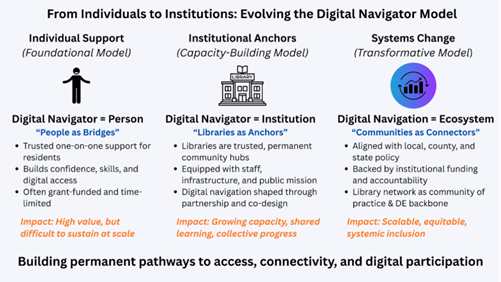
From individuals to institutions: Evolving the digital navigator model:
Individual Support
(Foundational Model)
Digital Navigator = Person
"People as Bridges"
- Trusted one-on-one support for residents
- Builds confidence, skills, and digital access
- Often grant-funded and time-limited
Impact: High value, but difficult to sustain at scale
Institutional Anchors
(Capacity-Building Model)
Digital Navigator = Institution
"Libraries as Anchors"
- Libraries are trusted, permanent community hubs
- Equipped with staff, infrastructure, and public mission
- Digital navigation shaped through partnership and co-design
Impact: Growing capacity, shared learning, collective progress
Systems Change
(Transformative Model)
Digital Navigator = Ecosystem
"Communities as Connectors"
- Aligned with local, county, and state policy
- Backed by institutional funding and accountability
- Library network as community of practice & DE backbone
Impact: Scalable, equitable, systemic inclusion
Building permanent pathways to access, connectivity, and digital participation
Digital Navigation Resources for Libraries
These resources, along with those on the on the RAILS Broadband and Digital Equity Pulse Page, may be helpful in describing specific community needs, assessing current organizational capacity, and identifying project priorities for your library.
Plans and Standards
- Cook County Digital Equity Action Plan
- Illinois State Digital Equity Plan
- Digital Navigator Model
- Digital Inclusion 101
- Illinois Public Library Standards
- Toward Gigabit Libraries Toolkit for technology infrastructure assessment
Data Sources
- Cook County Digital Equity Map
- Cook County Digital Equity Scores by Municipality
- U.S. Census Bureau My Community Explorer
- Your library’s Illinois Public Library Annual Report (IPLAR) data
- Local data available through municipalities, library surveys or strategic plan engagement processes, etc.
Definitions
Definitions are provided courtesy of the National Digital Inclusion Alliance (NDIA).
Libraries support digital equity with a range of digital inclusion and digital literacy services. These activities align closely with the American Library Association’s Core Values of Librarianship:
Core Library Values
- Access
- Equity
- Intellectual freedom and privacy
- Public good
- Sustainability
Digital Navigation at Libraries
- Skilled library workers
- One-on-one help
- Tech skills classes
- Device and hotspot lending
- Free wi-fi
- Public computers
- Adaptive technologies
- Telehealth booths
Digital Equity
"Digital Equity is a condition in which all individuals and communities have the information technology capacity needed for full participation in our society, democracy, and economy. Digital Equity is necessary for civic and cultural participation, employment, lifelong learning, and access to essential services. Also referred to as digital opportunity."
Digital Inclusion
"Digital Inclusion refers to the activities necessary to ensure that all individuals and communities, including the most disadvantaged, have access to and use of Information and Communication Technologies (ICTs). This includes 5 elements:
- affordable, robust broadband internet service
- internet-enabled devices that meet the needs of the user
- access to digital literacy training
- quality technical support
- applications and online content designed to enable and encourage self-sufficiency, participation and collaboration
Digital Inclusion must evolve as technology advances. Digital Inclusion requires intentional strategies and investments to reduce and eliminate historical, institutional and structural barriers to access and use technology."
Digital Literacy
As with basic print literacy, digital literacy is an essential prerequisite to many other forms of literacy.
"Digital Literacy is the ability to use information and communication technologies to find, evaluate, create, and communicate information, requiring both cognitive and technical skills.
A person with digital literacy skills:
- Possesses the variety of skills – technical and cognitive – required to find, understand, evaluate, create, and communicate digital information in a wide variety of formats;
- Is able to use diverse technologies appropriately and effectively to retrieve information, interpret results, and judge the quality of that information;
- Understands the relationship between technology, life-long learning, personal privacy, and stewardship of information;
- Uses these skills and the appropriate technology to communicate and collaborate with peers, colleagues, family, and on occasion, the general public; and
- Uses these skills to actively participate in civic society and contribute to a vibrant, informed, and engaged community."
This project is being supported, in whole or in part, by the Cook County Equity Fund.