
- Log in to post comments
“Hi!” A young woman, probably in her twenties, approached the Adult Services desk with an eager smile. “This might sound like a weird question, but could you help me find a newspaper from about fifteen years ago? There’s a photo of me sledding that ran in the Bartlett Examiner. I even have the exact date!”
I returned the greeting, eager to tell her that it was not a crazy request at all. In fact, it’s one we hear all the time. So many residents come to us looking for pieces of their past—articles that capture family milestones, community events, or summertime memories in Bartlett.
As I made my way to our storage closet, I remembered that my journey to find her newspaper may prove more difficult than I’d realized. The old, worn-down boxes and haphazardly stuffed newspapers presented a maze of information, and the location of the correct one could take some time. A plan to digitize the newspapers had been discussed, but having another patron request access to our tucked away collection was more proof that accessibility was crucial. Furthermore, the Bartlett Examiner, one of our two local newspapers, had just ceased publication a month prior. I located the box by the 2001written on the front in Crayola marker and after sifting through the packed box, located the exact newspaper. Several flips later and we had found and photocopied our patron’s sledding photo. I couldn’t help but think how much easier it could be with a digital newspaper in a searchable database. The quest to begin digitizing our newspapers was just beginning.
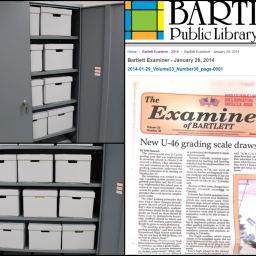
Our two newspapers, the Bartlett Examiner and Bartlett Press, span just under thirty-five years. The digitization of these would be a haul, but not impossible. Our team decided that a new storage space with better physical accessibility to the public in tandem with an online platform to search and browse, would provide the best accessibility to our residents. The newspapers would be relocated to a storage cabinet in The Hub, an open community room utilized for public desk space and genealogy research. It would be no easy feat, but we were determined.
For the digitization process, our library used the VIISAN Document Scanner, which was incredibly quick in scanning and document clarity. But even with a great scanner, a longer process presented itself in quality checking each newspaper to ensure visual clarity, proper orientation, amongst many other small details. Creating metadata for each newspaper was also a lengthy process as standards first needed to be set and then implemented. All in all, roughly 2,600 newspapers were scanned and stored in archival grade folders and boxes in a new cabinet for patron use. Despite being in a public space, our team decided on a locked cabinet. Using CONTENTdm as our digital platform, we created a separate online “collection” for each publication year. This makes it simple for patrons to jump right to the time period they’re looking for, search by keyword, or browse issue by issue. They can also view the entire archive in multiple languages, which helps make our local history accessible to even more people in our community.
Seeing everything finally organized, preserved, and easy to explore both in person and online felt incredibly rewarding. Families can now rediscover old memories; researchers can trace local history with ease, and new residents can learn more about the place they call home. Knowing that these stories will be accessible for years to come is something we’re deeply proud to share!
Today's blog post was written by Maggie Rountree, Adult Services Librarian at Bartlett Public Library District.
This project was made possible by the My Library Is... Grant.